The surge in metal prices has renewed speculation about a mining peak, a view that fails to reflect the industry’s structural realities. Two strong years do not reverse decades of neglect. In our view, what we have seen is a wake-up call, not a market top. Mining is defined by long development timelines, rigid supply growth, and capital cycles that unfold over decades, not quarters. The forces behind today’s repricing — prolonged underinvestment, constrained supply, and rising structural demand — remain intact and unresolved.
What we have seen to date is the awareness phase of a bull market. Institutions were caught off guard and rushed to deploy capital without sufficient industry knowledge, pushing prices higher across the sector.
At the core of the mining industry lies the cycle in metal prices. And at the center of that cycle stands gold. Gold sets the tone. Understanding its behavior is essential to understanding what will ultimately unfold across the broader metals complex. We are experiencing the beginning of one of the largest rotations out of financial assets and into hard assets in modern history, in our view. Comparing the size of the gold market to global equities cuts through narrative and underscores how early this rebalancing remains relative to financial assets.
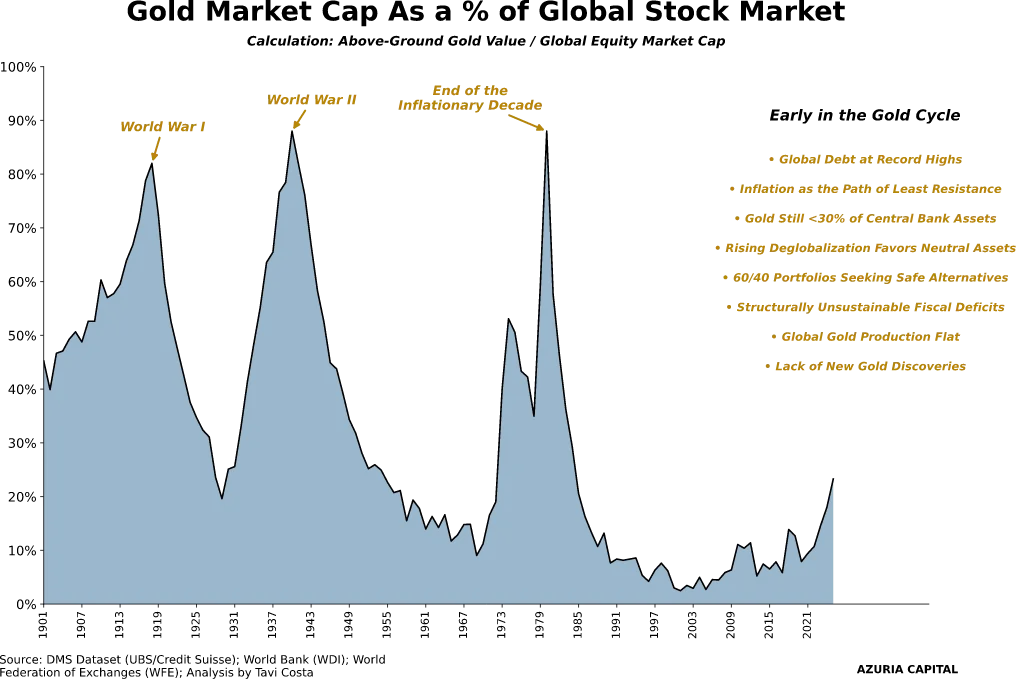
Neither the macro regime nor industry fundamentals point to late-stage conditions. Seen through this lens, recent price moves in hard assets are not signs of excess. They are the opening act of a much larger repricing, in our view.
The forces driving this shift are structural and self-reinforcing, including:
- Record sovereign debt driven by persistent twin deficits
- A constrained Federal Reserve limited by the rising cost of debt service
- A global system reliant on inflation to reduce leverage
- Accelerating central bank gold accumulation to restore monetary credibility
- Constrained supply of gold and critical metals after decades of underinvestment
Focusing on the US alone is instructive. During the last period of extreme debt expansion — World War II — US government debt surged to levels comparable to today. At that time, roughly 51% of federal debt was backed by gold reserves.
Today, total debt is even larger — yet only about 3% is backed by gold. This comparison powerfully illustrates just how deeply undervalued gold is on a historical basis.
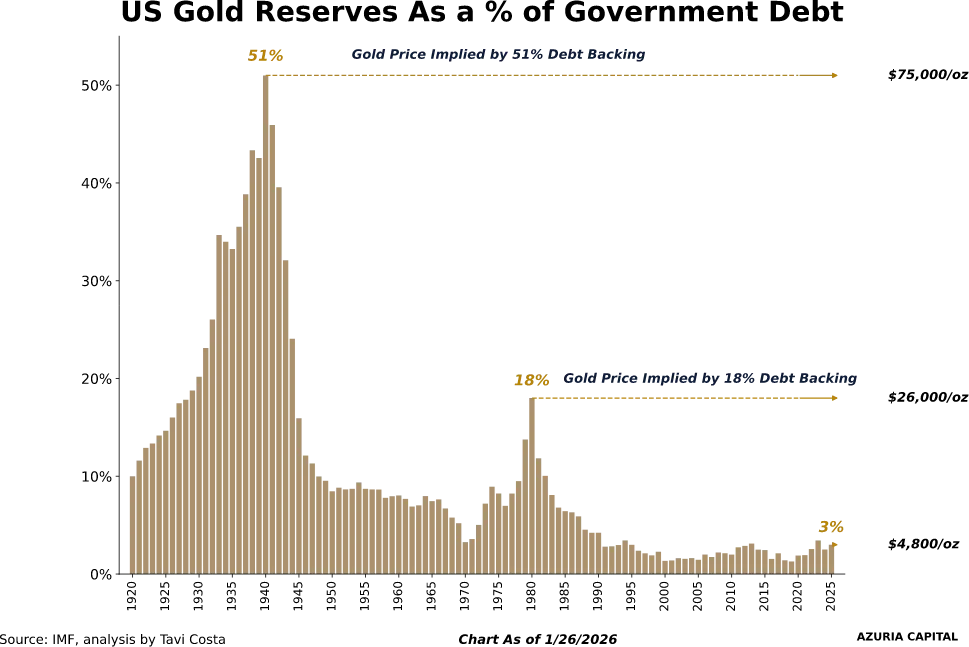
Without speculating or stretching assumptions, consider the math.
If US government debt were ever backed by gold at the same 51% level seen in the 1940s, total US gold reserves would need to be worth roughly $20 trillion. With 261.5 million ounces of gold, that implies a gold price near $75,000 per ounce.
Yes, those numbers will sound extreme to many — but they are not conjecture. They are the direct result of applying historical precedent to today’s balance-sheet realities. The gap between the size of sovereign debt and the monetary anchor that once underpinned it is now wider than at any point in modern financial history.
With that context in mind, we turn to what we view as the largest market dislocation today: mining equities.
For decades, this industry suffered from poor capital discipline, minimal exploration, stagnant production, and near-total abandonment by institutional investors. Talent left. New projects were not built. Mining stopped being viewed as a viable long-term career. The industry didn’t overbuild — it stood still.
What makes this moment unique is that mining isn’t being replaced or disrupted — it’s being rediscovered as essential. The world is relearning that metals sit at the foundation of everything we are trying to build next.
Deglobalization, supply-chain decoupling, and resource nationalism all point to the same conclusion. So does the massive need for reliable electricity to power AI, data centers, automation, and industrial reshoring. Add in record government debt and financial repression, and the direction becomes more evident.
All roads lead to metals.
From a demand perspective, this is not the final phase of the mining cycle, in our view — it is the first meaningful step forward after years of stagnation.
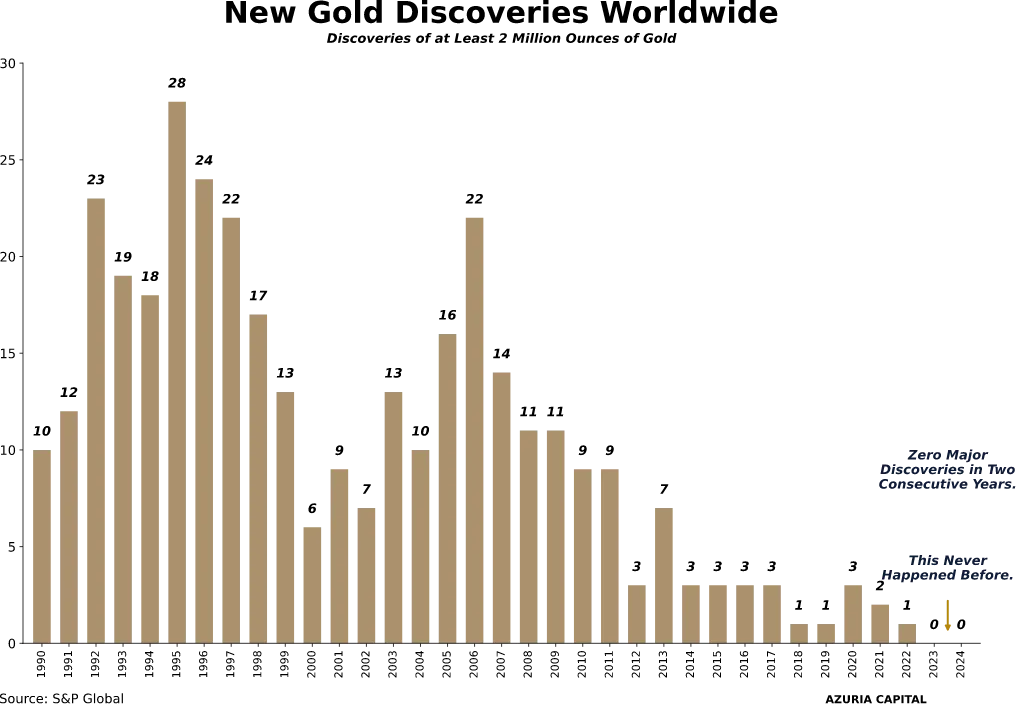
The new supply conundrum is a clear example. For the first time in recorded history, global data show zero gold discoveries in two consecutive years. This has never occurred before. And this is not unique to gold.
Major discoveries across most metals have fallen into the single digits, with no meaningful projects in the pipeline capable of materially altering the global supply curve.
The same excuse once used to dismiss senior gold miners is now being recycled to ignore silver equities. Underperformance is again being labeled “structural.” Last time, that framing proved wrong. We believe it is wrong again.
The disconnect is stark.
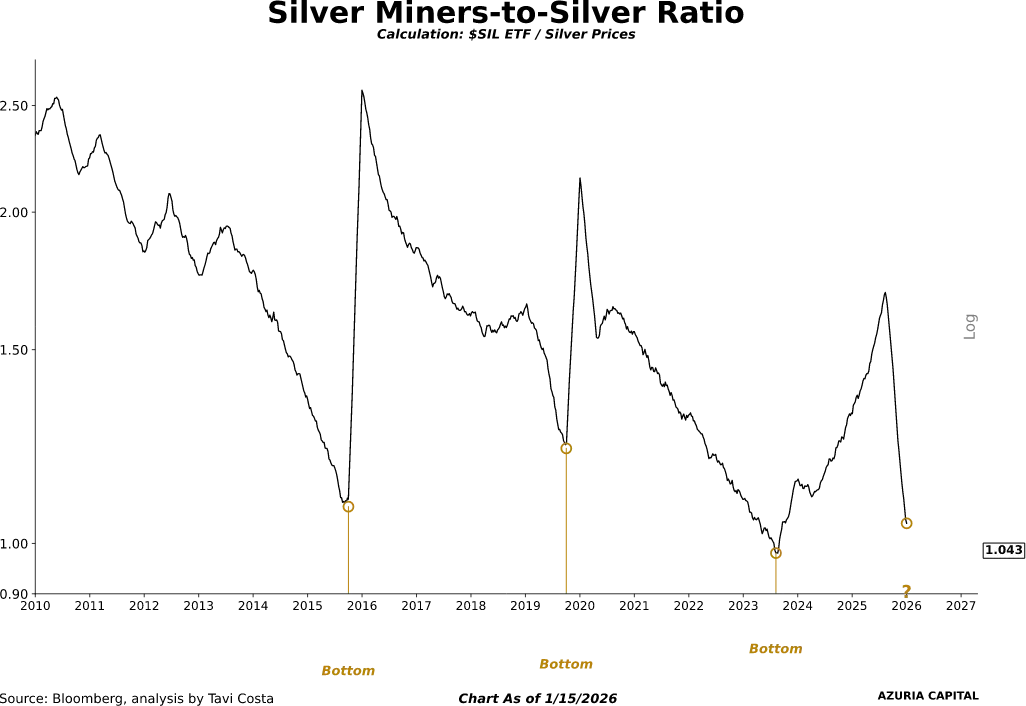
Silver mining equities are trading at historic valuation lows relative to the metal itself. Even under highly optimistic assumptions — significant new discoveries and sustained production growth — current valuations remain unjustifiably depressed, in our view.
For us, this is not a trade — and it never has been. Our process is about identifying major market dislocations and positioning ahead of the curve, not reacting to short-term price movements. Mining remains in a secular bull market in our opinion. Volatility is not a flaw in that thesis; it is how repricing occurs in capital-intensive industries.
Most primary silver producers continue to operate with all-in sustaining costs well below $20 per ounce. Yet current equity valuations only make sense if silver prices fall back toward those levels. That assumption requires a macro, monetary, and supply backdrop that we believe is largely behind us for the coming decade.
Few industries span the full arc of human economic history. Mining does. Long before markets, states, or currencies, the extraction of stone and metal enabled humanity’s first technological advances. What we are witnessing today is not a cycle’s end, but the rebirth of one of the world’s oldest and most essential industries. This is the reawakening of mining, metals, geoscience, and the material foundation of the global economy. Let the cycle continue.
Mining equities remain profoundly undervalued relative to metal prices and to the traditional assets that dominate institutional portfolios. Widespread misunderstanding of the industry and a shortage of capital allocators with genuine mining expertise have created a compelling opportunity within this niche segment of capital markets. We believe Azuria is positioned to be among the disciplined, informed stewards of capital in this space.